
Key facts: Board-Up and Tarping
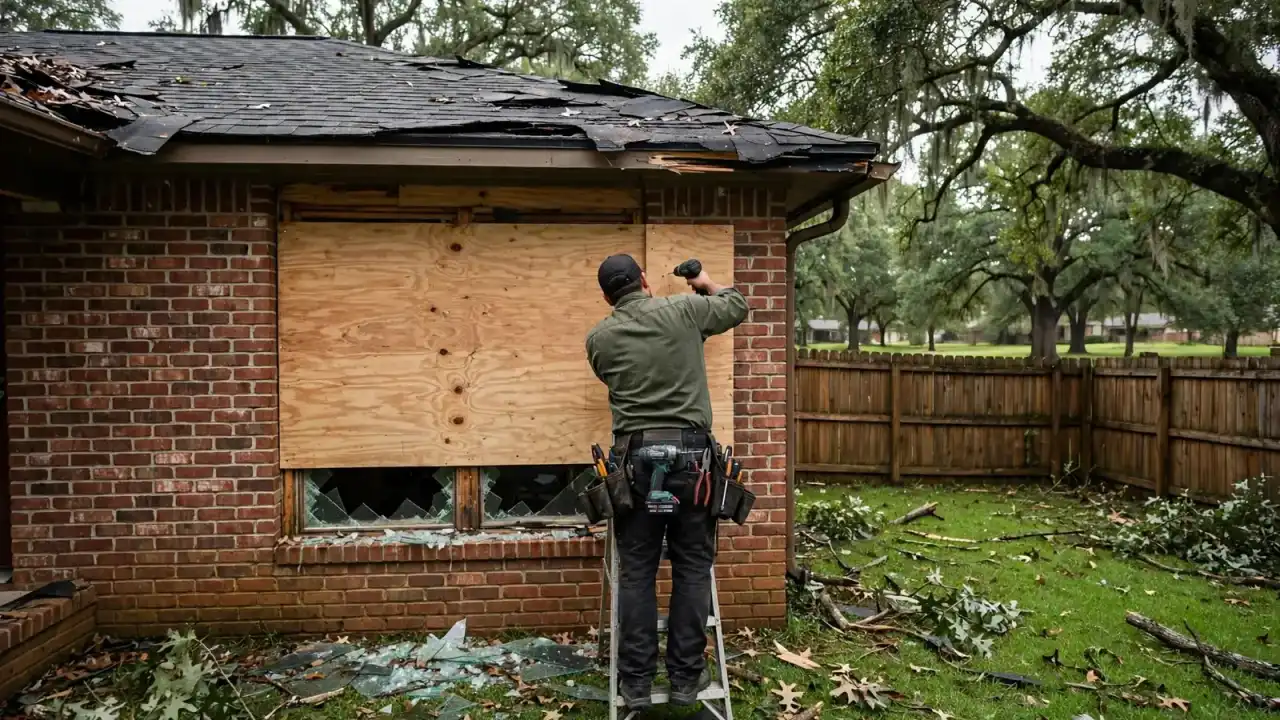
- Firefighters often break windows and cut roof openings to release heat and smoke, leaving the house open afterwards.
- Homeowner policies generally expect reasonable steps to protect the property from further damage after a loss [1].
- North Texas spring brings severe thunderstorms with hail and high wind [2].
- Board-up and roof tarps are temporary protection until permanent repairs are made.
- Photos of each opening before it is covered help document the loss.
The first job
Why a burned house needs closing up right away
Fires open houses in several ways. Heat cracks window glass and sometimes blows it out. Firefighters force doors to get in and may break windows deliberately or cut a hole in the roof to let heat and smoke escape, a tactic called vertical ventilation. Burned sections of roof, soffit and siding leave gaps of their own.
Every one of those openings makes the damage worse over time. Rain, and in North Texas sometimes hail, comes straight in. Wind blows dust and pollen across soot that is waiting to be cleaned. Birds, squirrels, rats and insects move into a quiet house quickly. An obviously damaged and empty home can draw trespassers and thieves after appliances, tools and copper wiring.
Board-up and tarping close those gaps temporarily. They do not repair anything, but they stop the loss from growing while the claim is processed and repairs are planned. Most homeowner policies expect owners to take reasonable steps to prevent further damage, and reasonable protective work is commonly part of a fire claim; check your own policy [1].
Walk-around
Openings to look for around the house
Cracked or broken windows
Heat-cracked glass may hold for now and fall later. Treat it as broken.
Forced front, back or garage entry doors
They may no longer latch or lock.
Roof ventilation cuts
Square holes cut by firefighters leave the attic open to the sky.
Burned soffit and fascia
Gaps under the roof edge let water and animals into the attic.
Damaged garage doors
A garage fire can warp or burn through the door, opening the garage and house.
Melted skylights and roof vents
Plastic parts melt, leaving holes that are hard to see from the street.
Common mistakes
Why quick fixes tend to fail
Taping plastic sheeting over a window or throwing a tarp over the roof and weighing it with bricks can help for an afternoon. North Texas wind usually ends that. Loose plastic tears, and an unsecured tarp acts like a sail, pulling at shingles and letting in more water than it keeps out.
Plywood fastened only into a window frame weakened by fire may not hold. On brick veneer homes, drilling into brick or mortar for anchors can crack masonry and leave permanent holes if done carelessly. Tarps that do not extend over the ridge let water run underneath. Professional board-up and tarping use methods designed to stay put through storms and to add as little damage as possible.
Planning
How a crew plans the work
- 1
Confirm it is safe
The fire department must have released the property, and the crew checks for unstable roof, overhangs and walls.
- 2
Photograph every opening
Each broken window, forced door and roof cut is photographed before it is covered.
- 3
Measure and choose fastening
Openings are measured, and the crew decides between fastening to framing, through window frames or with interior braces.
- 4
Prioritize
Roof openings and ground-floor doors and windows usually come first.
- 5
Keep one way in
A single secure, lockable entry is left for the owner and contractors.
What gets covered
Opening types and how they are usually secured
| Opening | Usual protection | Notes |
|---|---|---|
| Broken window in brick wall | Plywood fastened through the window frame or braced from inside | Avoids drilling brick where possible |
| Broken window in siding | Plywood screwed into surrounding framing | Glass cleared first |
| Sliding patio door | Plywood panel with bracing | Large openings may need framing |
| Forced entry door | Plywood or temporary door with hasp and lock | Keep one secure access |
| Roof ventilation hole | Plywood patch plus tarp over it | Tarp over the ridge |
| Burned roof area | Tarp with battens fastened to sound decking | Never fastened to charred wood |
| Damaged garage door | Plywood panels, framing or temporary fencing | Garages often hold salvageable items |
The process
How board-up and roof tarping are done
For windows, the crew removes loose glass from the frame and surrounding ground, then cuts plywood to overlap the opening. On brick veneer, the most common Arlington exterior, boards are usually fastened into the wooden window frame or held from the inside with braces and through-bolts, avoiding new holes in the brick. On siding, boards can be screwed into the framing behind. Doors are covered the same way, with one fitted with a hasp and padlock.
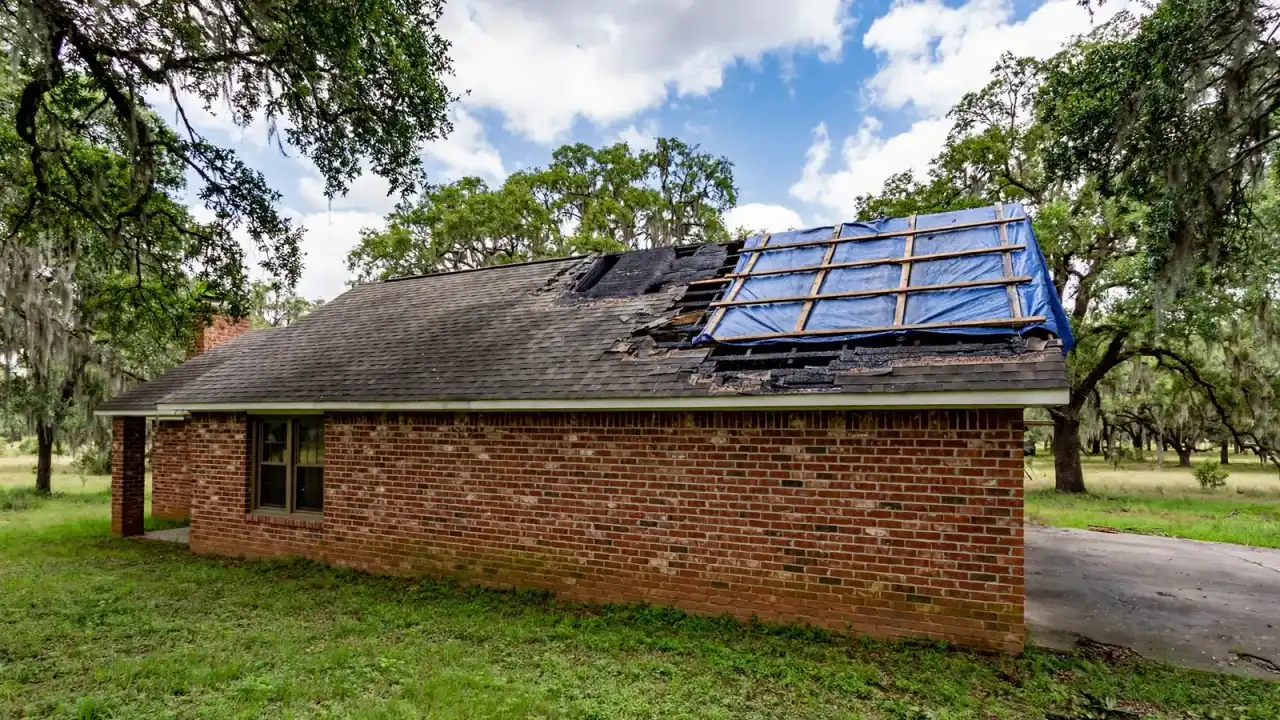
On the roof, the crew first decides whether it can be walked on safely; burned decking may not carry weight. Openings are covered with plywood where the structure allows, then a heavy tarp is laid over the area and well beyond it, extending over the ridge so water cannot run underneath. Wooden battens are screwed through the tarp into sound decking along its edges. Asphalt shingle roofs, the norm in Arlington, take this kind of fastening well; any nail holes are repaired when the roof is replaced.
Before leaving, the crew walks around the house, checks every covering and gives you photos and a list of what was secured. For a house that will stand empty, temporary fencing or periodic checks can be discussed with the contractor and your insurer.
Options
Temporary protection options compared
| Option | Good for | Limitations |
|---|---|---|
| Plywood board-up | Windows, doors, small roof holes | Darkens rooms and is not sealed |
| Heavy roof tarp with battens | Burned or ventilated roof areas | Needs ridge overlap and sound decking |
| Plastic sheeting | Interior dust barriers | Too weak for outside weather |
| Temporary fencing | Vacant or larger properties | Does not close the building itself |
| Temporary lockable door | Main entry | Needs a sound frame |
Owner steps
What you can do before a crew arrives
Only work outside once the fire department has released the property and you are sure nothing overhead is loose. Do not climb onto a fire-damaged roof; burned decking can give way. From the ground, photograph every side of the house, pick up broken glass from walks and driveways, and move valuables you can reach safely out of exposed rooms.
If storms are forecast and the crew has not arrived, cover salvageable belongings inside with plastic and move them away from roof openings. Leave the roof itself to people with fall protection.
- Wait for the fire department's release
- Stay off the roof
- Photograph every side
- Clear glass from walkways
- Cover belongings under openings
The visit
What happens during the board-up visit
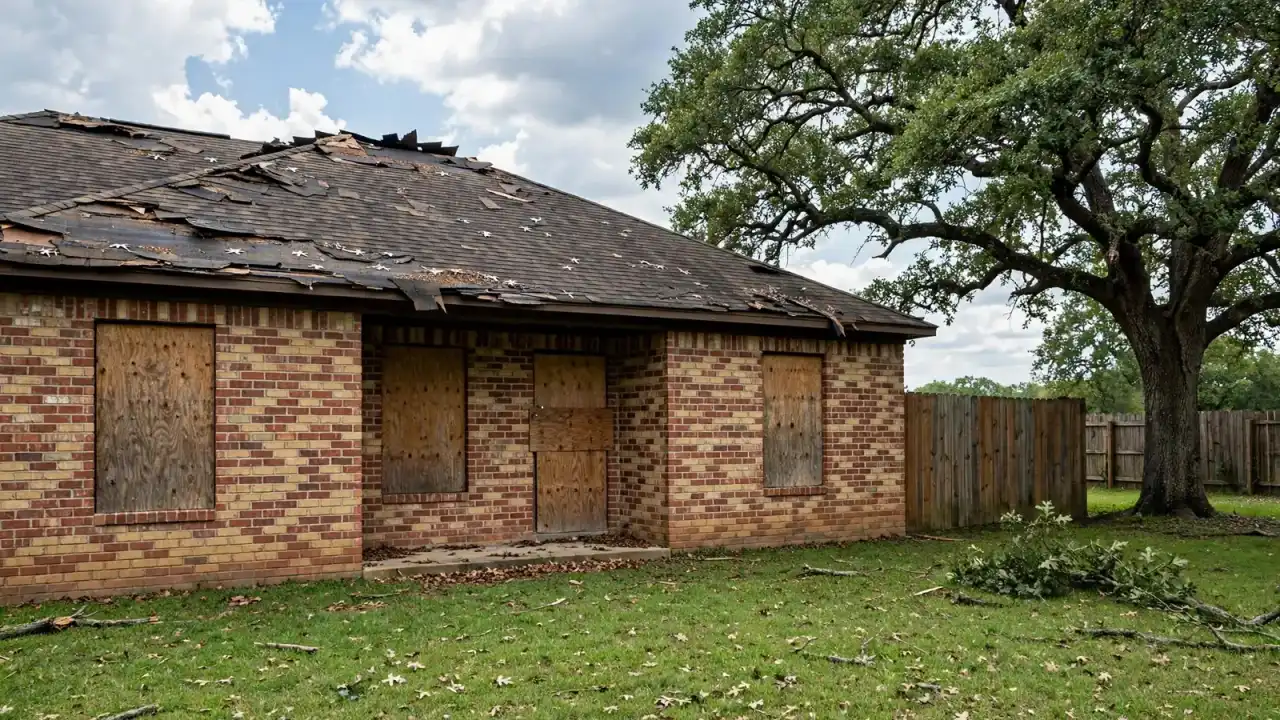
Board-up crews work fast. Expect a walk around the house, photos of each opening, and plywood being cut on site. They will ask which door should stay lockable and who should hold the key. If you need anything from inside, say so before the house is closed.
Roof work depends on weather. Crews avoid roofs in lightning, high wind and heavy rain, and in summer they prefer early mornings. If a storm is on the way, mention it on your call so the work can be scheduled ahead of it.
Ask for photos of the finished work for your records and your insurer.
Arlington specifics
Securing a fire-damaged home in Arlington
North Texas weather is the main reason board-up and tarping are urgent here. Spring and early summer bring severe thunderstorms with large hail, damaging straight-line winds and heavy rain, and the National Weather Service office in Fort Worth issues watches and warnings for the area regularly in that season [2]. A roof opening left uncovered through a single storm can let in far more water than the fire department used, and hail can shatter windows that survived the fire.
Arlington's housing shapes the methods. Most homes are brick veneer with composition shingle roofs and attached garages. Boarding without damaging brick, tarping shingles securely and closing a burned garage door are the everyday tasks. Older homes with wood siding and some newer homes with fiber-cement siding allow different fastening.
Many newer neighborhoods in Arlington, such as Viridian and subdivisions in south Arlington, have homeowners associations. Boarded windows and blue tarps are accepted as emergency measures, but it helps to tell the HOA about the fire and how long temporary protection is likely to stay.
Preparation
Making a future board-up easier
- Keep the roof in good repairSound shingles and decking around an opening hold tarps and battens well.
- Know your HOA rulesKnowing them ahead of time avoids friction during a stressful period.
- Keep a home inventoryPhotos of rooms and valuables make documenting exposed contents easier.
- Keep branches off the roofOverhanging limbs can carry fire to the roof and make tarping harder.
Temporary or permanent
How long temporary protection should stay up
Board-up and tarps are meant to last until permanent repairs begin, which can take weeks or a few months depending on the claim and the scope of rebuilding. During that time, check the tarp after every storm and windy day. Texas sun breaks tarps down faster than many people expect, so a tarp that will be in place for months may need replacing.
If the house will be empty for a long time, ask about sturdier options such as framed panels, temporary doors and fencing, and check with your insurer about any conditions for vacant properties.
Related
Next steps once the house is secure
Drying out
Firefighting water needs removing and drying quickly.
Read moreSoot cleanup
With the house closed, cleaning can begin.
Read moreHow to pick a contractor
What to ask before you hire anyone for the full job.
Read moreGarage fire cleanup
Burned garage doors and shared walls need extra attention.
Read more
Security
Keeping a vacant fire-damaged house safe
A house that has burned often sits empty while the claim is settled and repairs are planned. Empty, visibly damaged homes attract trespassers, scavengers after copper wiring and plumbing, and people looking for shelter. Board-up makes the house harder to enter and shows that someone is looking after it.
Some owners add temporary fencing, battery or solar motion lights and regular checks by a neighbor. Insurers may have conditions for vacant properties, so ask your adjuster whether anything specific is required. Take valuables, documents and anything easy to carry away out of the house as soon as it is safe, and ask the contractor about packing out salvageable contents to secure storage.
Inside the house
Protecting the inside while the outside is open
Some interior protection belongs in the same visit. Belongings under a roof opening can be moved or covered with plastic. Plastic sheeting across doorways separates damaged rooms from clean ones and slows the spread of soot and dust while work continues.
Boarded windows make the house dark, and the power may be off. Temporary battery or generator lighting along a clear path from the lockable entry makes inspections safer. Pests are another reason to close openings quickly: birds nest in attics opened by roof cuts, and rodents and insects move into a quiet house within days, adding droppings to the cleanup.
After bad weather
Checking temporary protection after storms
- 1
Look from the ground
Check that the tarp is still flat and fastened and that no boards have shifted.
- 2
Check ceilings and floors inside
Look for new drips or stains under roof openings.
- 3
Watch loose tarp edges
A flapping edge tears further in the next gust; report it quickly.
- 4
Look for hail damage
Hail can puncture tarps and crack windows that were not boarded.
- 5
Photograph and report
New damage after a storm should be documented and reported to your insurer and contractor.
Arlington construction
Brick veneer, siding and garage doors
Brick veneer is a single layer of brick tied to the wood-framed wall behind it with an air gap between. It does not carry the house, but it is easily cracked by careless drilling. Board-up crews usually fasten to the window frames themselves or brace boards from inside so the brick is not damaged. Where anchors in mortar joints are unavoidable, they can be patched later with matching mortar.
Homes with wood, vinyl or fiber-cement siding allow boards to be screwed into framing through the siding, with the small holes repaired when the siding is replaced or repainted. Garage doors damaged by a garage fire are usually closed with plywood panels on a simple frame, or with temporary fencing if the opening is too large, until a new door is installed.
On your call
Questions worth asking a board-up contractor
Ask how soon they can secure the house and whether roof work depends on weather. Ask how they fasten boards on brick to avoid damage and how they tarp a shingle roof. Ask which entry will stay lockable and who keeps the key.
It also helps to ask what they photograph and how you will receive the photos, whether they check temporary protection after storms, and what happens if a tarp or board is damaged before repairs. Finally, ask whether the same company handles drying and cleaning or only emergency securing, so you know what your next call needs to be.
Garages
Garage fires and the opening they leave
Garage fires are one of the most common fires in Arlington's attached-garage homes, and they often destroy the overhead door. A burned or warped garage door leaves the biggest opening in the house, and the garage usually connects directly to the kitchen or utility room. Closing it quickly protects whatever survived in the garage and stops weather and intruders reaching the house through the inside door.
Crews usually build a simple frame across the opening and sheathe it with plywood, leaving a lockable access door if needed. If the overhead door is still in place but damaged, it may be secured in the closed position.
FAQ
Board-up questions from Arlington homeowners
Why did the fire department break my windows?
Breaking windows and cutting roof openings let heat and smoke escape so crews can reach the fire and reduce the risk of a flashover. It is standard firefighting practice.
Do I have to board up the house?
Most homeowner policies expect reasonable steps to prevent further damage, and board-up and tarping are the usual ways to meet that duty. Check your policy.
Can I put a tarp on the roof myself?
It is not recommended. Fire-damaged roofs can be unstable, and a loosely fastened tarp can blow off or tear shingles.
Will boarding damage my brick?
It can if anchors are drilled carelessly. Crews usually fasten to the window frame or brace from inside to avoid new holes in brick.
How long can a roof tarp stay on?
Until permanent repairs, but sun and wind wear tarps down. Check after storms and replace if torn or brittle.
What about my burned garage door?
It can be closed with plywood panels and framing or temporary fencing until a new door is installed.
Can I still get into my house?
Most crews keep one door lockable for access. Let them know who holds the key.
What if hail is forecast?
Mention it when you call. Roof openings and windows should be covered before the storm.
Can a burned house sit boarded up for months?
It can, but check tarps and boards after storms, replace tarps that degrade in the sun and keep your insurer informed if the house will be vacant for a long time.
Will the board-up crew take my valuables out?
Many contractors can pack out salvageable contents to secure storage with a written inventory. Ask on your call.
Do I need permits for temporary board-up?
Emergency board-up and tarping are temporary protection. Permanent repairs, such as reroofing or replacing windows, normally need City of Arlington permits.
Will a tarp stop hail damage?
No. A tarp keeps rain out, but hail can still puncture it. Check and replace the tarp after hailstorms.
What if glass is still hanging in the frame?
Leave it for the crew. Heat-cracked glass can drop without warning; they remove loose pieces before fastening boards and clear shards from the yard.
Can boards go on the inside instead?
Sometimes. Interior bracing avoids marking brick and looks tidier from the street, but it depends on access and the condition of the frame.
Should I tell my neighbors the house is empty?
It helps. Neighbors who know the house is vacant are more likely to notice and report trespassers or storm damage.
Who pays for board-up?
Reasonable protective work is commonly part of a fire claim under many homeowner policies, but coverage depends on your policy. Ask your adjuster.
Can the crew secure a burned fence or gate?
Many can add temporary fencing or patch gates so pets and visitors stay out of a damaged yard.
Does board-up keep out dust and pollen?
Mostly. Plywood blocks wind-driven dust and pollen far better than open windows or loose plastic, though small gaps remain.