
Key facts: Soot Removal
- Soot is carbon-rich residue from incomplete burning, mixed with tars and acids that vary with what burned.
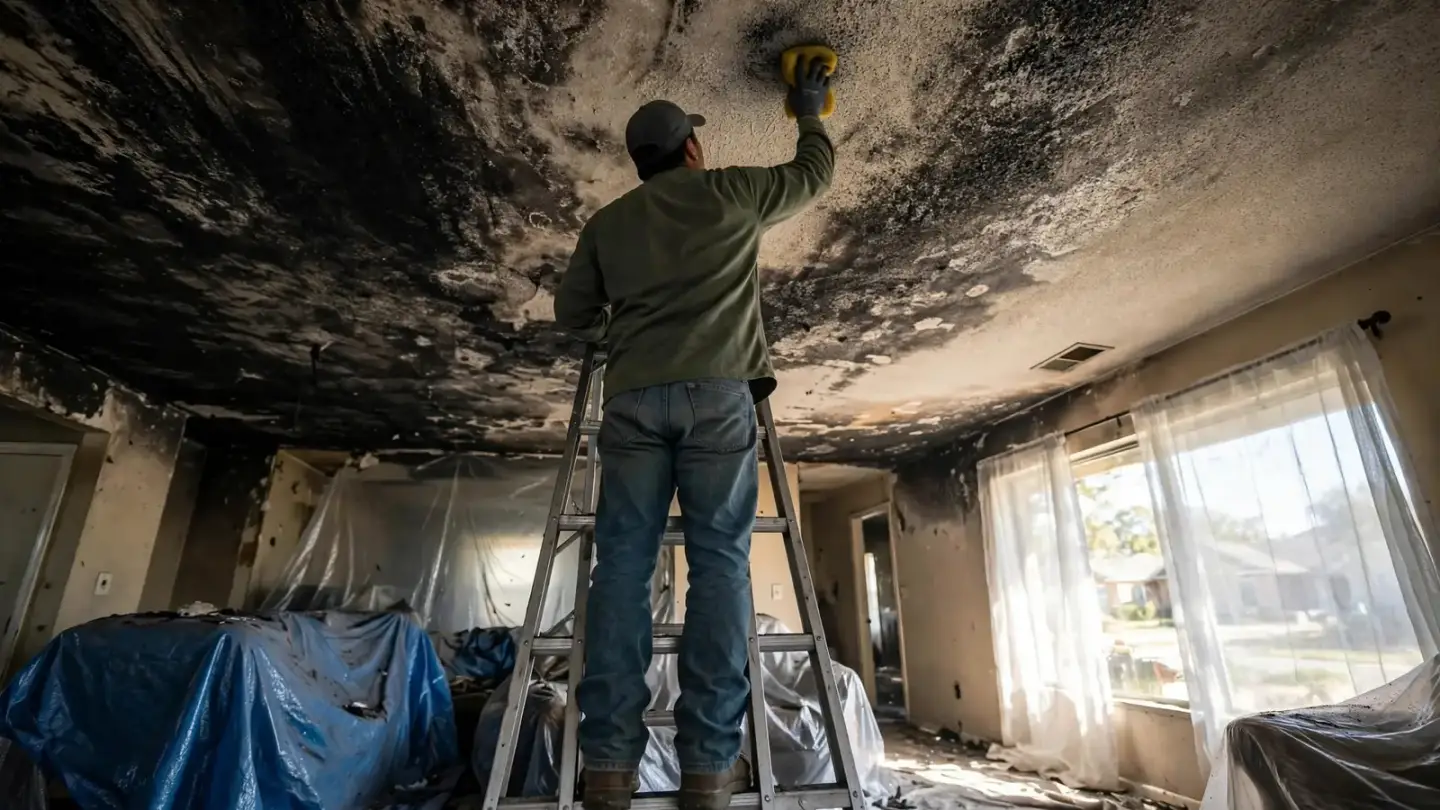
- Textured ceilings and brick trap soot in their surface, so they are harder to clean than smooth paint.
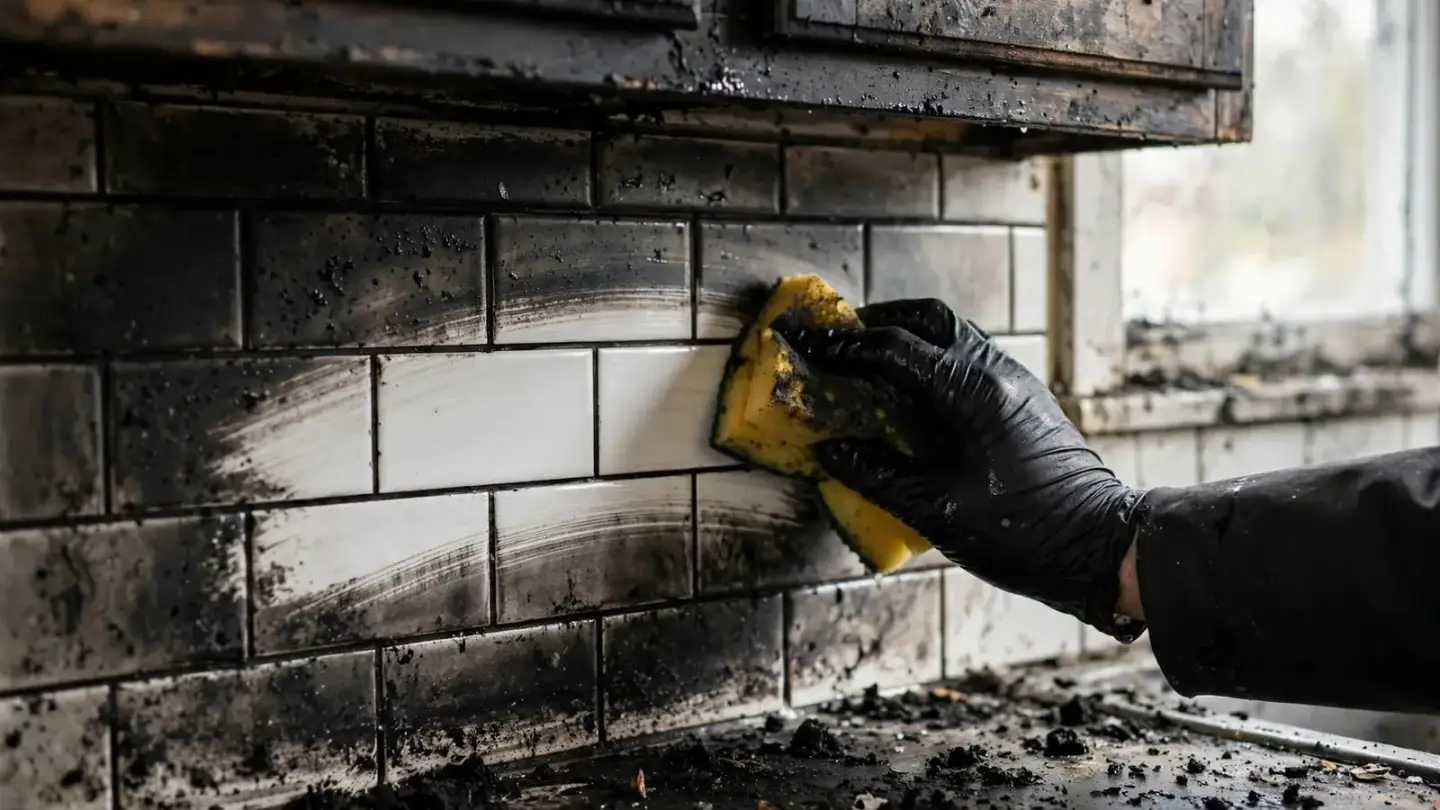
- Dry methods such as HEPA vacuuming and dry sponges are normally used before wet cleaning to avoid smearing.
- Fine particles in soot can irritate the lungs, so respirators and gloves are standard during cleanup [1].
- Restorers in the U.S. commonly reference the IICRC S700 document for fire and smoke work [2].
Understanding soot
The black film is more than dirt
Soot forms when something burns without enough oxygen to finish the job. Instead of turning completely into gas and heat, part of the fuel breaks into tiny carbon particles and sticky by-products that rise with the hot smoke and settle wherever they cool. In a house, that means ceilings first, then the upper walls, then anything with a cool or textured surface that particles can grip.
What burned determines what you are cleaning. A fast fire in wood and paper leaves a dry grey-black powder. A slow, smoky fire in a recliner, a mattress or a garage full of plastic bins leaves a dark, greasy film that smears. A pot left on a burner leaves a pale, sticky residue that is hard to see but impossible to ignore by smell. Most real fires produce a mixture, and the mixture changes from room to room depending on how far the smoke travelled and how much it cooled on the way.
That is why professional soot removal starts with diagnosis, not scrubbing. Someone has to work out what kind of residue is on each surface before choosing how to remove it.
Soot is also mildly acidic in many fires. Left in place for days, it can etch metal fixtures, cloud glass, yellow white plastics and discolour grout. Prompt cleaning matters for that reason as well as for appearance.
Where it settles
Arlington surfaces that hold soot
Brick fireplaces and accent walls
Rough, porous brick catches soot in every pore and mortar joint. Water alone pushes it deeper; dry and masonry-specific methods are needed.
Orange-peel and popcorn ceilings
Spray textures have peaks and hollows that trap particles. Wiping can flatten texture or leave streaks, so methods are chosen carefully.
Stained oak cabinets
Many Arlington kitchens from the 1970s to 1990s have oak cabinets with a clear finish. Soot dulls the finish and can creep into the grain at worn edges.
Wood paneling in dens
Older dens and game rooms often have real or veneer paneling, which absorbs soot and odor unevenly.
Vinyl blinds and window frames
Plastic surfaces attract fine soot through static and yellow quickly if residue sits.
Ceiling fans
Fan blades sweep smoke during a fire and end up coated on top; turning a fan on afterwards throws residue across the room.
How it travels
Why soot ends up in rooms that never burned
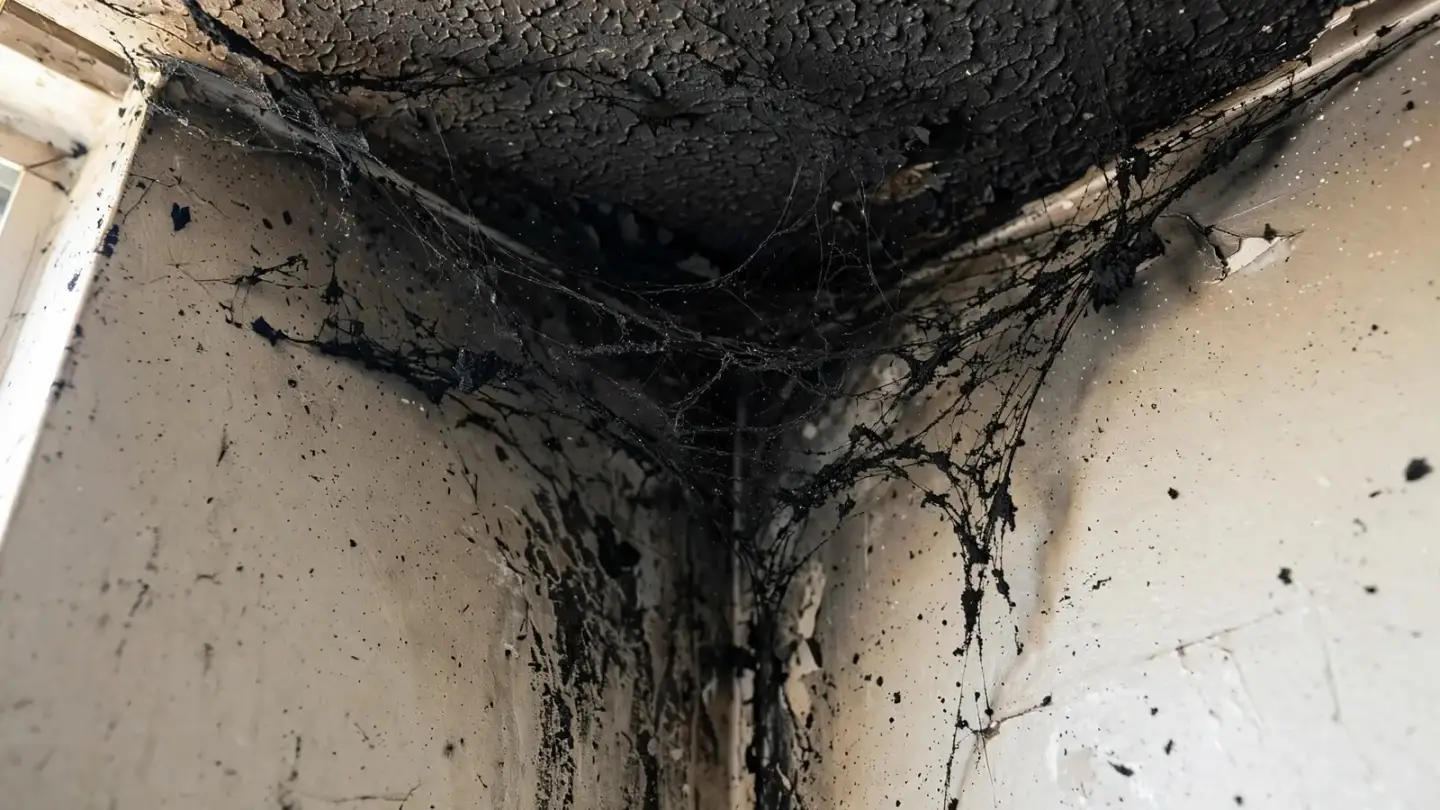
Fire pushes smoke outward under pressure. It slips under doors, through gaps around ceiling lights and attic hatches, along the top plates of interior walls, and through the duct system if the heating or air conditioning was running. In a single-storey brick ranch, which describes a large share of Arlington's older housing, the attic acts like a highway across the whole house, carrying smoke above the ceilings from one end to the other.
Cool surfaces pull particles out of the air. Exterior walls in winter, ceilings beneath an uninsulated patch of attic and the outer side of closets all show darker soot than the room around them. Lines that follow ceiling joists, or a dark rectangle around where a picture hung, are signs of this effect.
Static charge makes plastics, electronics and synthetic fabrics act like magnets for fine soot. A television in a bedroom at the far end of the house may wear a grey film even when the bedroom walls look fine.
For cleanup, the takeaway is to inspect every room, closet and cabinet, the attic and the ducts. Soot that is missed keeps shedding particles and odor into the house.
Diagnosis
Testing before the first wipe
These quick checks prevent the most common mistake, and the hardest to undo: smearing soot into a surface.
- 1
Dry sponge stroke
A single pass of a dry chemical sponge on an inconspicuous spot shows whether soot lifts cleanly (dry) or smears (oily or protein).
- 2
Surface identification
The technician notes paint sheen, texture type, masonry, wood finish or fabric, because each tolerates different cleaners.
- 3
Small wet test
A mild cleaner is tried in a hidden spot to check for bleeding, swelling or texture damage.
- 4
Odor and acidity check
Strong odor or etching on metal suggests residue that needs faster action or sealing.
- 5
Asbestos question
For ceiling textures applied before the 1980s, testing is arranged before anything is scraped or heavily cleaned.
Diagnosis
Reading what the soot is telling you
| What you see | Likely source | Usual first step |
|---|---|---|
| Grey dust that wipes off on a finger | Hot fire in wood or paper | HEPA vacuum, then dry sponge |
| Black film that smears | Plastics, foam or garage contents | Dry pass, then a degreasing cleaner |
| Tacky yellow film in the kitchen | Burned food on the stove | Protein-specific cleaner |
| Black in brick pores and mortar | Smoke rising past a fireplace wall | Dry methods, then masonry cleaning |
| Dark stripes along the ceiling | Cool framing pulling particles | Clean, then stain-blocking primer |
| Grey haze on a far bedroom TV | Fine charged particles | Electronics-safe cleaning |
The process
How an Arlington soot job is usually carried out
Work runs top to bottom and dry to wet. Crews begin at the ceiling so residue knocked loose falls onto areas not yet cleaned. Loose particles come off first with HEPA-filtered vacuums, which trap fine soot instead of exhausting it back into the room. Dry chemical sponges, made of vulcanised rubber, follow on walls and smooth ceilings; they grab residue rather than smearing it.
Textured ceilings get special care. Light soot on orange-peel texture can often be lifted with dry sponges used gently. Heavy soot on popcorn texture is difficult to clean evenly, and many restorers recommend sealing and re-texturing or removing it, after testing for asbestos if the texture is older.
Brick is cleaned with dry brushing and vacuuming first, followed by masonry-safe detergents applied with soft brushes and rinsed with minimal water. Heavily blackened fireplace walls may need gentle media blasting. Mortar joints are given the same attention as the brick faces, because that is where soot hides.
Cabinets, paneling and wood trim are cleaned with products suited to their finish, then evaluated. If the finish is dulled, a refinish is often a better option than replacement. Painted drywall that cleans but still shows a shadow is primed with a stain-blocking primer and repainted.
Methods
Matching method to surface
| Method | Works well on | Avoid on |
|---|---|---|
| HEPA vacuum with brush | Every surface, as a first pass | Nothing; it is always step one |
| Dry chemical sponge | Flat paint, light texture, wallpaper | Greasy residue, heavy popcorn texture |
| Alkaline detergent | Gloss paint, laminate, tile | Unsealed wood, natural stone |
| Degreaser | Oily soot on hard surfaces | Some plastics and finishes |
| Masonry cleaner and soft brush | Brick, stone, block | Painted drywall |
| Media blasting | Charred framing, heavy brick soot | Finished interior walls |
| Ultrasonic tank | Small hard contents | Electronics, porous items |
Before help arrives
What you can do while you wait
Stop the spread first. Switch the thermostat fan to off so the air handler is not circulating particles. Close doors to the worst rooms. Lay old sheets over carpet in the paths you have to walk. Keep children and pets out of sooty areas.
Resist the urge to clean. Wiping soot with a damp cloth, running a regular vacuum or turning on a ceiling fan almost always makes the job bigger. If you need clothes or medicine from an affected room, wear gloves, take what you need and leave the rest for the crew.
- Thermostat fan off
- Doors closed on sooty rooms
- No damp rags on soot
- No ceiling fans
- Photos before anything moves
The visit
What the crew does on arrival
Expect a walk-through first. The contractor will ask what burned, how long it burned, whether water was used and whether the heating or air conditioning was on. They will look at every room, open closets and cabinets, check the attic hatch area and look at return-air grilles. Point out anything you have noticed, such as a smell in a hall closet or a film on a bathroom mirror.
Containment comes next. Plastic sheeting goes across doorways to keep cleaned and dirty areas separate, and air scrubbers with HEPA filters may run during the work. Salvageable contents are either cleaned in place or packed and taken for off-site cleaning, with an inventory you should receive a copy of.
Because the contractor you speak with is an independent business, ask on the call how they record their work. Room-by-room photos, a contents list and notes on what was cleaned, sealed or removed make an insurance claim much easier.
Arlington specifics
What is different about soot in North Texas homes
Much of Arlington was built in the 1960s through the 1990s, and the typical house from that era is single-storey brick veneer over a wood frame, with sheetrock walls, sprayed ceiling texture and a vented attic above. Brick on the outside rarely needs more than cleaning after an interior fire, but brick fireplaces and accent walls inside take soot deeply. The attic over a ranch layout spreads smoke the length of the house.
Texas weather plays a part. In summer, attics above Arlington homes get extremely hot, which drives smoke odor out of soot-coated insulation and roof decking and into the rooms below. In winter, furnaces and space heaters run, and a furnace that was operating during a fire may have distributed soot through every duct. Spring storms bring the risk of rain through a fire-damaged roof, which wets soot and makes it harder to clean.
Older homes in central and downtown Arlington may have pier-and-beam floors with a crawlspace below. Smoke can enter the crawlspace through floor openings and leave residue on the underside of the subfloor and on ductwork running beneath the house. A thorough soot job in those homes includes a look underneath.
Prevention
Keeping soot problems small next time
- Burn clean candles, or noneLarge or untrimmed candle flames leave soot on walls and ceilings over time. Trim wicks and keep candles away from drafts.
- Service the furnace and water heaterGas appliances that burn poorly can puff soot and may produce carbon monoxide.
- Use a higher-grade HVAC filterPleated filters changed on schedule catch more fine particles every day and during a small incident.
- Keep garages tidyPlastic bins, paint and fuel near a water heater or chest freezer turn a small fire into a heavy-soot event.
- Learn where the thermostat fan switch isTurning it off quickly during a fire stops the system pushing soot through the house.
Deciding
Clean it, seal it or replace it
Hard, non-porous surfaces almost always clean: glass, glazed tile, metal, laminate and sealed counters. Painted sheetrock usually cleans and then gets a stain-blocking primer and fresh paint. Brick and stone clean with the right methods. Textured ceilings, unsealed wood, grout and fabrics are less predictable.
Anything blistered, warped, melted or charred is generally removed regardless of how clean it gets, because heat changes the material itself. Insulation that took smoke is usually replaced. A good contractor explains each decision and photographs materials before they go.
Related
Problems that usually come along with soot
Smoke odor that lingers
Odor lives in porous materials after visible soot is gone.
Read moreWet materials from the fire hose
Wet soot is harder to remove, so drying comes first.
Read moreSmoke throughout the house
Rooms far from the fire often carry a lighter film.
Read moreBroken windows and roof holes
Openings let in dust and storms until they are covered.
Read more
Contents
Soot on belongings: what gets cleaned where
Walls and ceilings are only half of a soot job. Dishes, picture frames, lamps, toys, tools and decor all carry residue, and so do the insides of drawers and cabinets if the doors were open or ill-fitting. Hard items usually go through hand cleaning or ultrasonic tanks, which use high-frequency sound in a cleaning bath to lift soot from crevices that a cloth never reaches.
Soft items are sorted by fabric and by how heavily they were exposed. Clothing and linens go to cleaners equipped for smoke; upholstered furniture is cleaned on site or taken away; rugs are cleaned or replaced. Books, papers and photographs need gentle dry cleaning methods and, if wet, may be frozen until they can be dried properly.
Electronics deserve a warning of their own. Soot is conductive and often acidic, and a device that was in a smoky room can short or corrode when powered on. Leave televisions, computers, game consoles and small appliances unplugged until they have been looked at.
Special cases
Soot after a garage or attic fire in Arlington
Garage fires are common in Arlington's attached-garage homes and produce some of the heaviest, oiliest soot a restorer sees, because garages hold plastics, tyres, fuel, paint and vehicles. The shared wall and the door into the laundry or kitchen are the main paths into the house, and the attic over the garage often connects to the attic over the living space. Cleanup for a garage fire usually involves the garage structure, the attic, and every room that opens toward the garage.
Attic fires, sometimes started by electrical faults, lightning or heat from old light fixtures, leave soot on roof decking, rafters and insulation and drop it through ceiling openings. Charred framing may need structural assessment. Soot-coated decking and rafters that are still sound are often cleaned with blasting methods and then sealed to lock in residue and odor.
Timing
How long typical soot stages take
| Stage | What happens |
|---|---|
| Day 1 | Walk-through, containment, contents sorted |
| Days 1-3 | Water removal and drying if firefighting water was used |
| After drying | HEPA vacuuming and dry sponging, top to bottom |
| Following days | Wet cleaning, masonry cleaning, contents cleaning |
| Final stage | Sealing, repainting and refinishing where needed |
FAQ
Arlington soot removal questions
Can I clean soot off my brick fireplace myself?
A light layer can sometimes be vacuumed and dry-brushed, but scrubbing with water usually drives soot deeper into brick and mortar. Heavy fireplace soot is best left to masonry-safe methods.
Does a popcorn ceiling have to come down after a fire?
Not always. Light soot can sometimes be cleaned or sealed. Heavy soot often means removal or re-texturing, and older textures should be tested for asbestos first.
Why is there soot in my bedroom at the other end of the house?
Smoke travels through the attic, wall gaps and ducts, especially in long single-storey homes, and settles on cooler surfaces far from the fire.
Should I turn the ceiling fan on to clear the air?
No. Fan blades are usually coated with soot on top, and switching them on throws it across the room.
Is soot harmful to breathe?
Fine particles can irritate the lungs and worsen asthma and heart conditions. Limit time in affected rooms and wear a fitted N95 if you must go in.
Can stained oak cabinets be saved?
Often. They are cleaned with finish-safe products and, if the clear coat has dulled, refinished rather than replaced, unless they warped from heat or soaked up water.
Will paint cover soot stains?
Not on its own. Surfaces need cleaning and a stain-blocking primer, or the stain and smell come back through.
What is the IICRC S700?
It is an industry document describing recommended practice for fire and smoke cleanup. You can ask the contractor you speak with whether their crew follows it.
How do I keep soot from spreading while I wait?
Turn the thermostat fan off, close doors to the sootiest rooms, cover walkways with old sheets and keep people and pets out of affected areas until cleaning starts.
Can soot damage my metal fixtures?
Yes. Acidic residue can tarnish and pit chrome, brass and nickel within days, so faucets, hinges and hardware are usually cleaned early in the job.
Does soot get under a pier-and-beam house?
It can. Smoke enters crawlspaces through floor openings and vents, leaving residue on the subfloor underside and any ducts running beneath the house.
Do smoke-stained blinds need replacing?
Metal and wood blinds usually clean. Vinyl blinds that yellowed or warped from heat are often simpler to replace.
Will my wood paneling come clean?
Real wood paneling with an intact finish often cleans well. Thin veneer or unfinished paneling that absorbed heavy soot and odor is more often sealed or replaced.
Can soot stain grout?
Yes. Grout is porous and darkens with soot; it is cleaned with grout-safe products and sometimes resealed afterwards.