
Key facts: Firefighting Water Damage
- Water used to fight a fire spreads beyond the burned area and soaks materials that may look dry on the surface.
- The EPA advises drying water-damaged materials within 24 to 48 hours to help prevent mould growth [1].
- Firefighting water picks up soot and debris, so porous materials it soaks are often removed rather than dried in place.
- Ceilings holding water can sag and fall; keep everyone out from under them.
- Many restorers follow the IICRC S500 document for water damage work [2].
Water after a fire
The damage that arrives with the fire trucks
Firefighters put out house fires with water because nothing else cools burning material as quickly or as safely. A hose line can deliver a great deal of water in a few minutes, and only part of it turns to steam. The rest runs across floors, soaks into walls, pools on top of ceilings and finds the lowest point it can reach.
That is why water damage after a fire is often more widespread than the fire itself. A bedroom fire may burn one wall and a ceiling, while the water used to stop it soaks the hallway carpet, the closet floors and the ceiling of the room below. Insulation in walls and attics can be saturated even where the surface looks only damp.
The water is also dirty. By the time it settles it carries soot, ash, burned debris and chemical residue, which stains materials, adds to odor and makes cleaning harder. For all these reasons, drying is normally the first major task after the house is secured, and soot cleaning cannot be finished until it is done.
Homes with fire sprinklers see far less water, because a sprinkler head releases water only where heat triggered it. But even one activated head leaves an area that needs drying.
Warning signs
Signs water is still hiding in the house
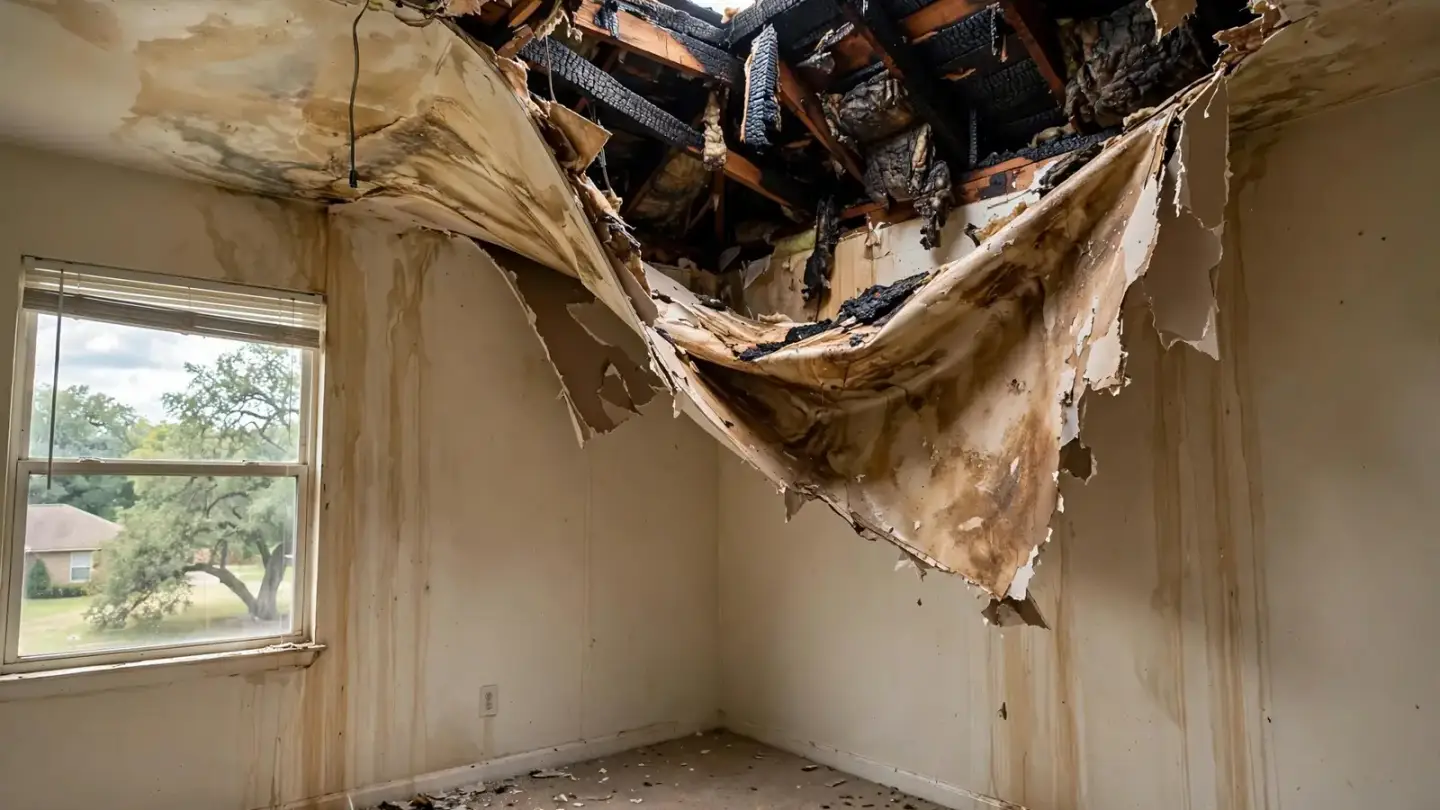
Sagging or bubbled ceilings
Water pooling above sheetrock makes it heavy and can bring it down. Keep away.
Swollen baseboards and door casings
Trim wicks water from wet floors and swells at the bottom.
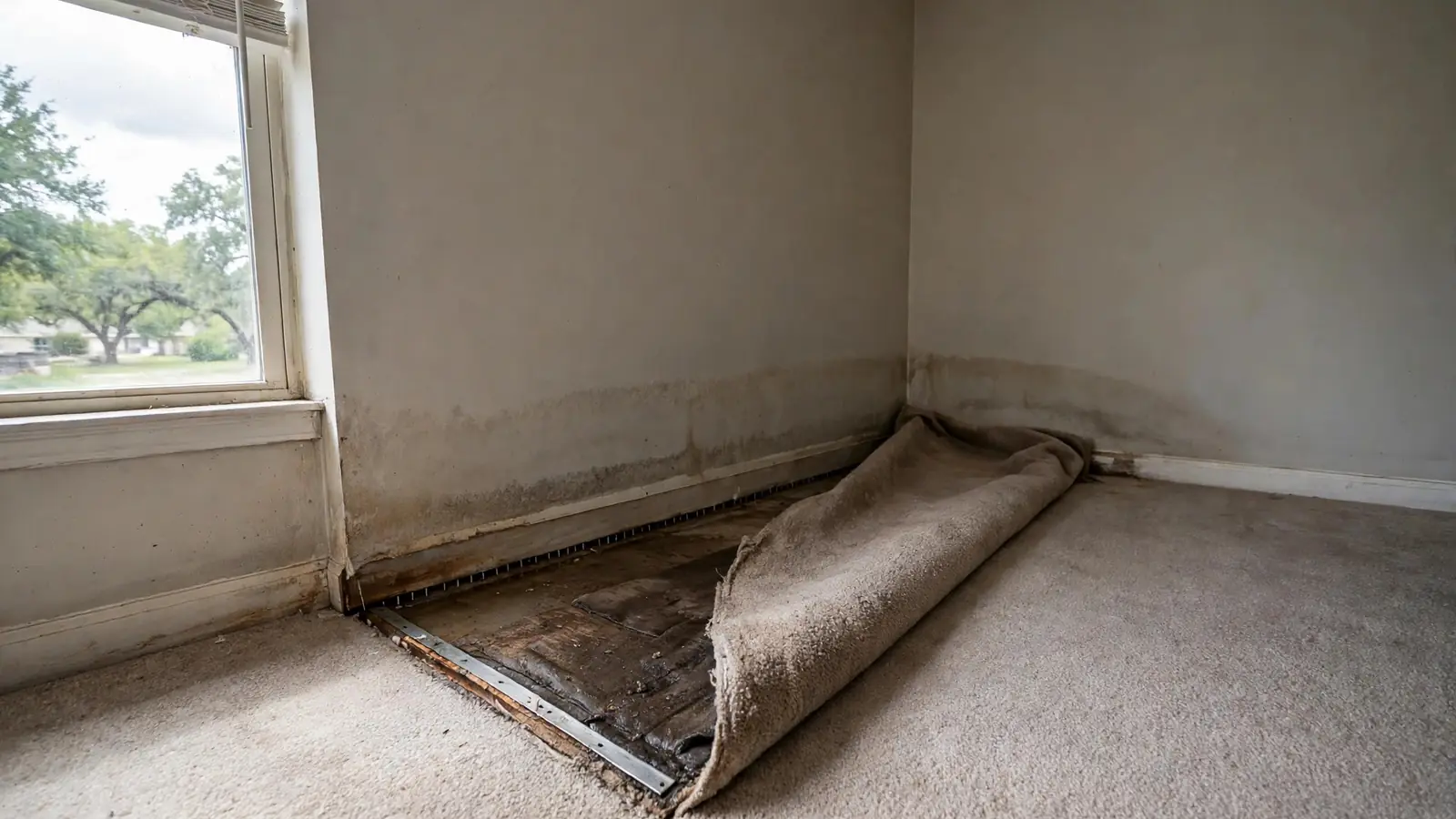
Brown tide lines on walls
A stain partway up the wall shows how far water wicked upward.
Squishy carpet rooms away
Water travels along floors and under walls into neighbouring rooms.
A musty smell after a few days
A sign that mould may have started on damp materials.
Loose floor tiles or peeling paint
Moisture beneath has broken the bond.
Why speed matters
What happens if the water is left to dry on its own
Building materials are not designed to stay wet. Sheetrock softens and crumbles. Particleboard in cabinets and some furniture swells and falls apart. Wood floors cup and buckle. Insulation compresses and stops insulating. Nails, electrical boxes and metal fasteners begin to rust.
Mould is the bigger threat. Spores are present everywhere, and they only need moisture, something organic to feed on and a reasonable temperature. Sheetrock paper, wood, dust and carpet backing all qualify. The EPA advises drying water-damaged materials within 24 to 48 hours to help prevent mould growth [1]. A closed, warm house after a fire, especially in a humid North Texas summer, gives mould good conditions.
Water trapped in wall cavities, under cabinets, beneath floor coverings and in crawlspaces is shielded from room air. Without targeted drying equipment and, often, some removal of materials, it can stay wet for weeks.
Measuring
How wet areas are found and mapped
- 1
Look for the obvious
Standing water, stains, swelling and tide lines show the clear areas first.
- 2
Meter the hidden areas
Pin and pinless moisture meters read inside sheetrock, wood and flooring.
- 3
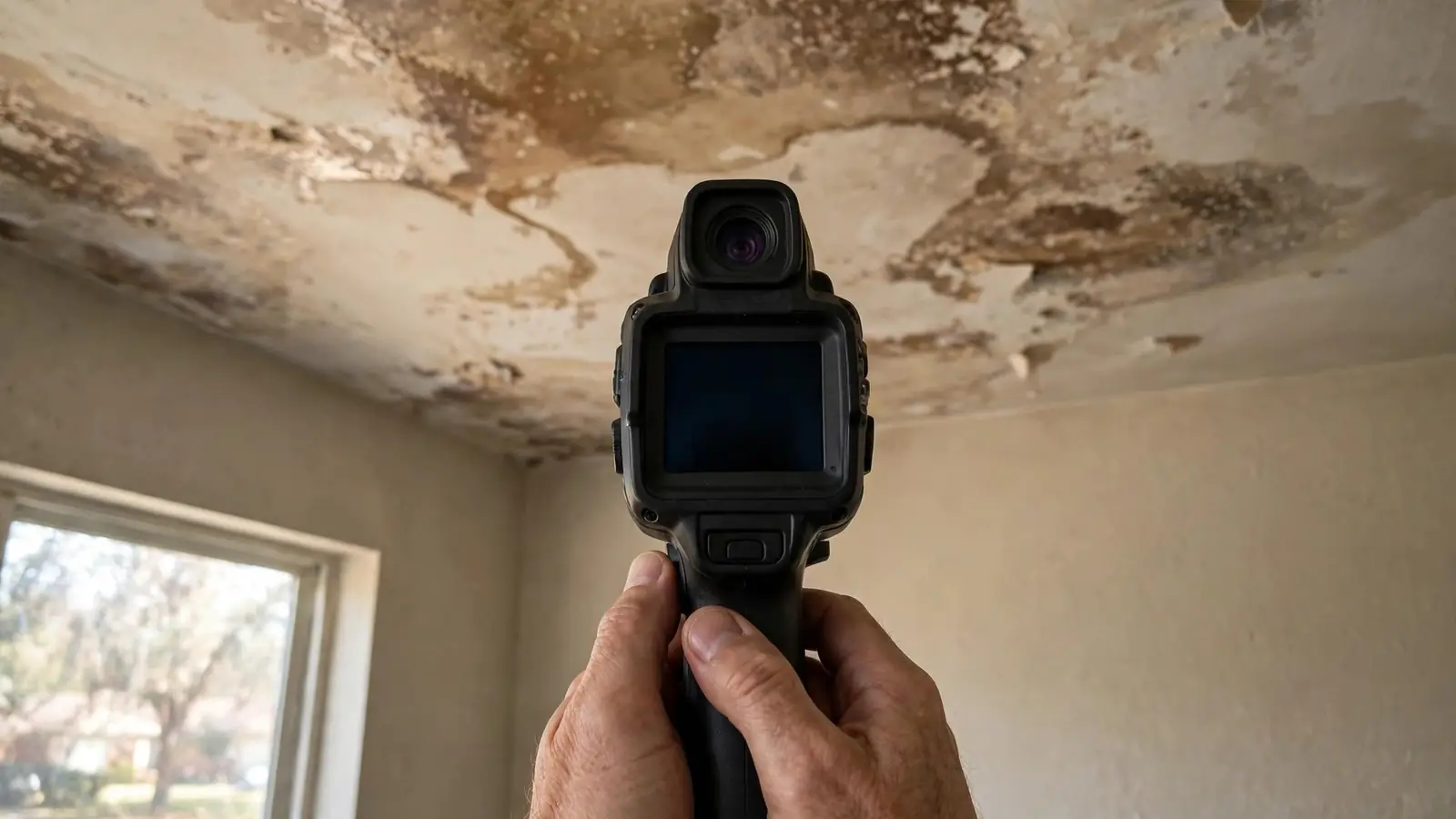
Scan with thermal imaging
Infrared cameras show cool patches behind surfaces, which are then checked with meters.
- 4
Take dry readings
Materials in unaffected rooms give a baseline for what dry looks like in this house.
- 5
Draw the moisture map
Readings are marked on a floor sketch and repeated every day to track progress.
Diagnosis
Water clues and what they mean
| What you see | What it usually means | Typical response |
|---|---|---|
| Standing water on floors | Heavy hose use | Extraction with pumps and vacuums |
| Ceiling bulging below the fire | Water pooled on sheetrock above | Controlled removal, then dry the cavity |
| Tide line on hallway walls | Water wicked up from wet carpet | Cut sheetrock above the line, dry the wall |
| Swollen bathroom vanity base | Particleboard soaked | Remove and replace the cabinet box |
| Wet carpet two rooms away | Water ran under the walls | Lift carpet, discard pad, dry the slab |
| Damp smell from floor vents | Water reached the crawlspace or ducts | Crawlspace drying and duct check |
The process
How an Arlington house is dried after a fire
Extraction comes first. Portable or truck-mounted units pull standing water out of carpet and off hard floors far faster than evaporation ever could. Soaked debris, ash and ruined contents are removed at the same time.
Next, materials that cannot dry in place come out. Carpet pad is usually discarded. Sheetrock that is soaked, or has wet insulation behind it, is cut away above the wet line, often a foot or two above the floor. Wet ceiling sheetrock and insulation are removed. Swollen particleboard cabinets and baseboards come off. Opening these areas lets dry air reach the framing.
Then drying equipment goes in. Air movers push air across wet surfaces, dehumidifiers pull moisture out of that air, and specialty setups can force dry air into wall cavities, under cabinets or into a crawlspace. In North Texas, outdoor air is often humid, especially in spring and summer, so drying usually relies on dehumidifiers in a closed space rather than open windows.
Progress is measured daily. Technicians re-read moisture, move equipment as areas dry and log the results. When materials match the dry baseline, the equipment comes out and the job moves on to soot cleaning, odor control and rebuilding.
Materials
Dry in place or take it out
| Material | Usually | Why |
|---|---|---|
| Carpet pad | Removed | Soaks up dirty water and is easy to swap out |
| Carpet | Sometimes dried, often replaced | Depends on how sooty it got and how long it stayed wet |
| Sheetrock, lightly damp | Dried in place | Recovers if dried quickly |
| Sheetrock, soaked | Cut out | Loses strength; cavity behind must dry |
| Wall and attic insulation | Removed | Holds water and odor |
| Solid wood framing | Dried in place | Recovers well once dry |
| Particleboard cabinets | Usually replaced | Swells and falls apart |
| Hardwood floors | Dried, then refinished if possible | May cup; some boards replaced |
Before the crew arrives
Safe first steps with the water
Make sure power to wet areas is off before going near standing water; the fire department or Oncor may already have disconnected it. Do not plug in fans or a shop vac until the circuits are cleared.
If it is safe, mop small amounts of standing water, move undamaged belongings to a dry room, put furniture legs on foil or blocks, and open cabinet doors to let air in. Photograph everything that is wet before moving it, and keep out of any room with a sagging ceiling.
- Power off in wet areas
- Photos before moving things
- Dry belongings to a dry room
- Stay out from under sagging ceilings
- Gloves on; the water is dirty
The visit
What the drying crew does on day one
The first visit is busy. The crew inspects, reads moisture, photographs, extracts standing water, removes soaked materials and sets up equipment. They will ask that the equipment stays running, because switching it off slows drying.
Drying equipment uses a lot of electricity and makes noise. If the power is off, the contractor may bring a generator or arrange temporary power. Ask how many days they expect and how often they will come back to read moisture.
Keep a copy of the moisture logs. They show your insurer that the home was dried properly, which matters if questions about mould come up later.
Arlington specifics
Drying a fire-damaged house in North Texas
Most Arlington homes sit on concrete slabs over expansive clay soil, with carpet, tile, wood or laminate laid directly on the slab. Water that gets under tile or laminate on a slab can take a long time to dry and may need specialized drying mats or the removal of some flooring. Water pooled against a slab foundation outside also deserves attention, since clay soils swell when wet.
Older homes, particularly around downtown and central Arlington, may have pier-and-beam floors over a crawlspace. Water that drips through the floor collects on the ground below, raises humidity under the house and soaks insulation fastened beneath the subfloor. Drying these homes means drying the crawlspace too, often with dehumidifiers and air movers placed underneath.
North Texas humidity and spring storms slow drying and raise mould risk. If the fire left a roof opening, the next thunderstorm can add far more water than the fire department used. Getting the roof tarped is part of the drying plan.
Prevention
Reducing water damage if there is ever a fire
- Consider sprinklers in a remodelResidential sprinklers control fires with much less water than hose lines.
- Keep an extinguisher in the kitchenA small fire put out early needs no hose at all.
- Know where your water shut-off isIf fire damages plumbing, closing the main stops a second flood.
- Keep gutters and roof in good repairA sound roof is easier to tarp quickly after a fire.
Dry or remove
How restorers decide what wet material stays
Three questions guide each decision: how wet is it, how long has it been wet, and what was in the water? Lightly damp sheetrock dried within a day or two can usually stay. Soaked sheetrock, sheetrock with wet insulation behind it and anything showing mould usually goes. Particleboard rarely survives. Solid wood and concrete are dried rather than replaced.
Because firefighting water carries soot, porous materials it soaked are more likely to be removed than after a clean pipe leak. A contractor should explain each decision and back it up with photos and moisture readings.
Related
Damage that travels with firefighting water
Wet soot
Wet soot sets more stubbornly and needs careful cleaning methods.
Read moreMusty smoke smell
Damp materials hold odor and must dry before deodorizing works.
Read moreRoof and window openings
Openings let storm water in until covered.
Read moreGarage fires
Garage floors and shared walls often take a lot of hose water.
Read more
Two storeys
Upstairs fires and wet ceilings in two-storey homes
In two-storey homes, common in south and southwest Arlington and in Viridian, a fire upstairs sends hose water down through the floor into the cavity between the floors and onto the sheetrock ceiling below. That ceiling can hold a surprising amount of water before it sags. Recessed lights and ceiling fans mounted in it may fill with water, and the insulation and wiring in the floor cavity get soaked.
Drying usually means opening sections of the downstairs ceiling so air can reach the joists and subfloor, removing wet insulation, and running air movers and dehumidifiers until readings are back to normal. Light fixtures and fans in that ceiling should be checked by an electrician before use. If you see a stain or bulge below a fire area, keep everyone out from under it and mention it at the start of your call.
Cabinets
Kitchens, bathrooms and cabinets after firefighting
Water that reaches a kitchen or bathroom runs under the toe kicks of cabinets and soaks the bottom of the boxes, which in many Arlington homes are particleboard or MDF. These materials swell and lose strength quickly and are hard to dry. Even when cabinet faces are solid wood, the boxes behind them may not be.
Contractors often remove the toe kick panels to let air under the cabinets, drill small holes behind baseboards to ventilate wall cavities, or pull lower cabinets entirely if they have swollen. Countertops are supported or removed carefully when cabinets come out. Dishwashers, ranges and refrigerators are pulled to dry the floor beneath them.
Floors
Hardwood, laminate and tile on Arlington slabs
Floor coverings react differently to firefighting water. Solid hardwood absorbs water and cups, with board edges rising above the centers. If dried carefully and soon enough, many hardwood floors flatten and can be sanded and refinished; badly cupped or buckled boards are replaced. Laminate flooring has a fiberboard core that swells permanently and is usually replaced once soaked.
Ceramic and porcelain tile do not absorb water, but water can sit in the grout and in the thin layer between tile and slab. Specialized drying mats that pull moisture through the surface can help. Loose or hollow-sounding tiles are a sign water got underneath. Carpet on the slab is lifted, the pad is discarded, and the slab is dried before anything new goes down.
Timing
A typical drying timeline
| Day | What happens |
|---|---|
| Day 1 | Extraction, removal of soaked materials, equipment set up, first readings |
| Day 2 | Readings, equipment adjusted, more material removed if needed |
| Days 3-4 | Most surfaces approach dry; dense materials still drying |
| Days 4-5+ | Final readings at the dry standard; equipment removed |
| After drying | Soot cleaning, odor control and rebuilding begin |
Belongings
Wet contents after a fire
Wet belongings need attention within hours. Furniture standing in water wicks it into legs and frames; lifting pieces onto blocks or moving them to a dry room helps. Rugs should be lifted and sent for cleaning. Piles of wet clothes and linens start to smell and can grow mould within a few days in warm weather.
Paper is the most time-sensitive. Wet photographs, documents and books stick together and grow mould quickly. Freezing wet paper items buys time until they can be dried properly by a specialist. Electronics that got wet should stay unplugged; water and soot together can short circuits and corrode connections.
On your call
Questions worth asking a drying contractor
Ask how they measure moisture and how often they will return to take readings. Ask whether they expect to remove sheetrock, flooring or cabinets, and why. Ask how they will dry under tile, under cabinets and in any crawlspace, and whether they need temporary power if the electricity is off.
It is also reasonable to ask how they handle contaminated water and wet debris, how the drying log will be shared with you, and what happens if they find mould.
FAQ
Arlington questions about water after a fire
How much water do firefighters use on a house fire?
It varies with the size of the fire and how it was fought. Even a small room fire can leave enough water to soak floors and walls in several rooms.
How quickly can mould grow after a fire?
The EPA advises drying materials within 24 to 48 hours to help prevent mould. In a warm, closed house, growth can start quickly.
Can wet sheetrock be saved?
Lightly damp sheetrock dried quickly often can. Soaked sheetrock or sheetrock with wet insulation behind it is usually cut out.
Why are they cutting holes in my walls?
To remove wet material and let air reach the framing and cavity, which otherwise stay wet for weeks.
Does my crawlspace need drying too?
If water dripped through a pier-and-beam floor, yes. Damp crawlspaces raise humidity and can grow mould under the house.
Is firefighting water dangerous to touch?
It is mixed with soot, ash and debris, so wear gloves and boots and rinse any skin it touches.
How long does drying take?
Often several days, depending on materials and weather. Daily moisture readings show when materials are dry.
Is fire hose water covered as part of the fire claim?
Water used to put out a covered fire is generally treated as part of the fire loss, but check your policy and ask your adjuster.
Will my hardwood floors be ruined?
Not necessarily. Floors dried promptly often flatten enough to be sanded and refinished. Badly buckled or charred boards are replaced.
Why are my lower cabinets being removed?
Particleboard boxes swell and weaken when soaked and are hard to dry in place. Removing them also lets the wall and floor behind them dry.
Should I freeze wet photos and papers?
If they cannot be dried properly within a day or two, freezing them in sealed bags stops mould until a specialist can dry them.
Can I use my own fans to help?
Only after an electrician has cleared the circuits. Household fans help a little but do not replace dehumidifiers and air movers.
Will tile floors need to come up?
Not always. Water under tile can sometimes be dried with mats. Loose or hollow-sounding tiles usually need lifting.
Can mould grow inside walls I cannot see?
Yes. That is why contractors read moisture in wall cavities and open them when insulation is wet.
Do I need to empty the house for drying?
Usually not entirely. Belongings in wet rooms are moved out or raised, and the rest of the house can often stay as it is.
Why does my house feel humid after the fire?
Water evaporating from wet materials raises indoor humidity. Dehumidifiers bring it down and speed drying.